← PROJECTS · 06
ELECTRICCharger connector health from charging curves
Concept study with working prototype, developed independently, not client work.
PROTOTYPE RESULTS
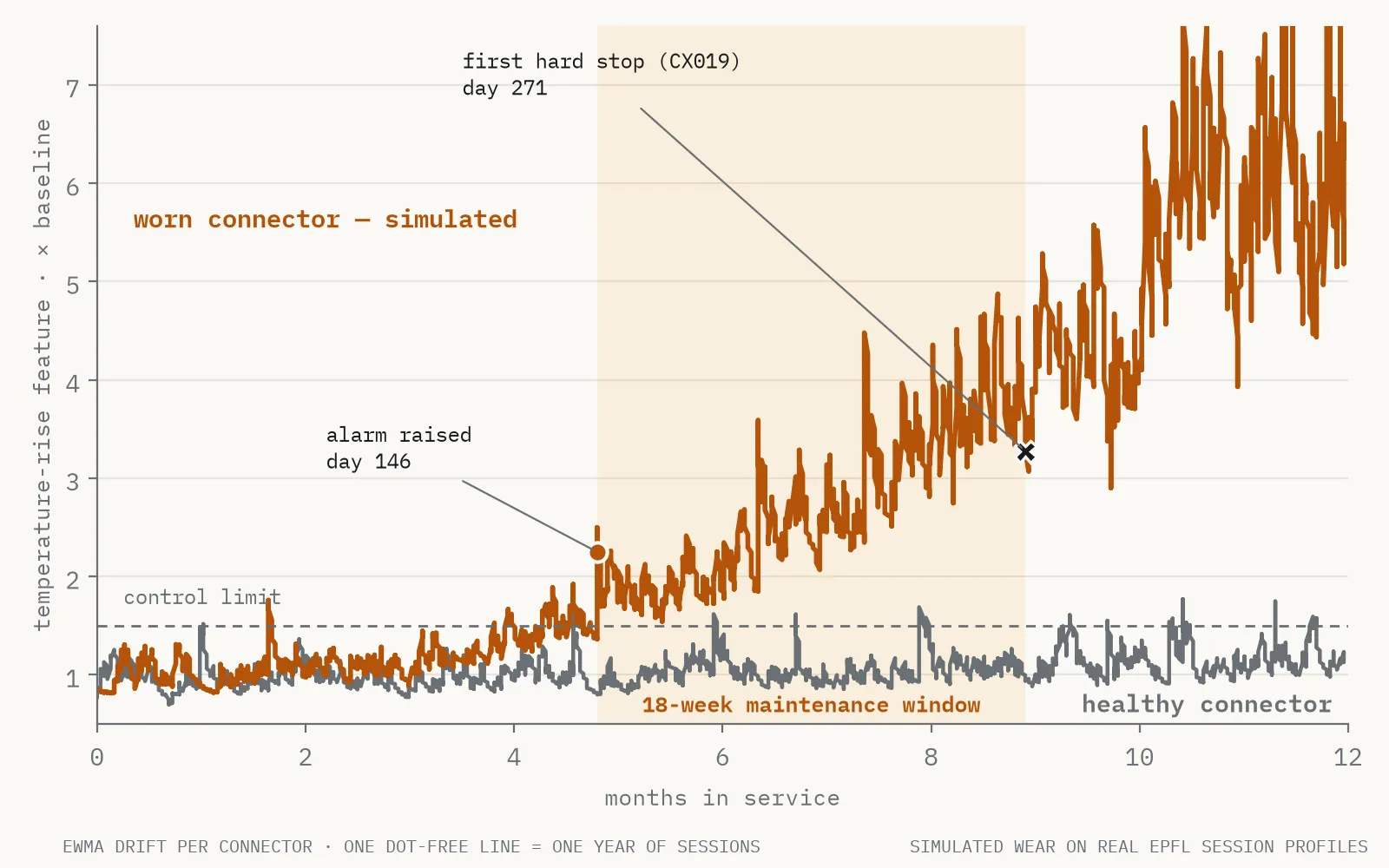
In the simulated year, the fastest-wearing connector triggered its alarm 18 weeks before its first hard over-temperature stop, enough lead time to schedule the repair as planned maintenance.
TO VALIDATE IN A PILOT
A pilot would compare the features and alarms with measured connector wear and cooling faults. The simulated warning time is not a validated forecast for an operating charger.
THE CHALLENGE
Public fast chargers lose reliability with age. A Berkeley field study found 73 % of 657 public CCS chargers functional, and first-time charge success drops from about 85 % on new hardware to under 70 % by year three. Uptime monitoring misses much of this: a station can be online and still deliver far less power than requested.
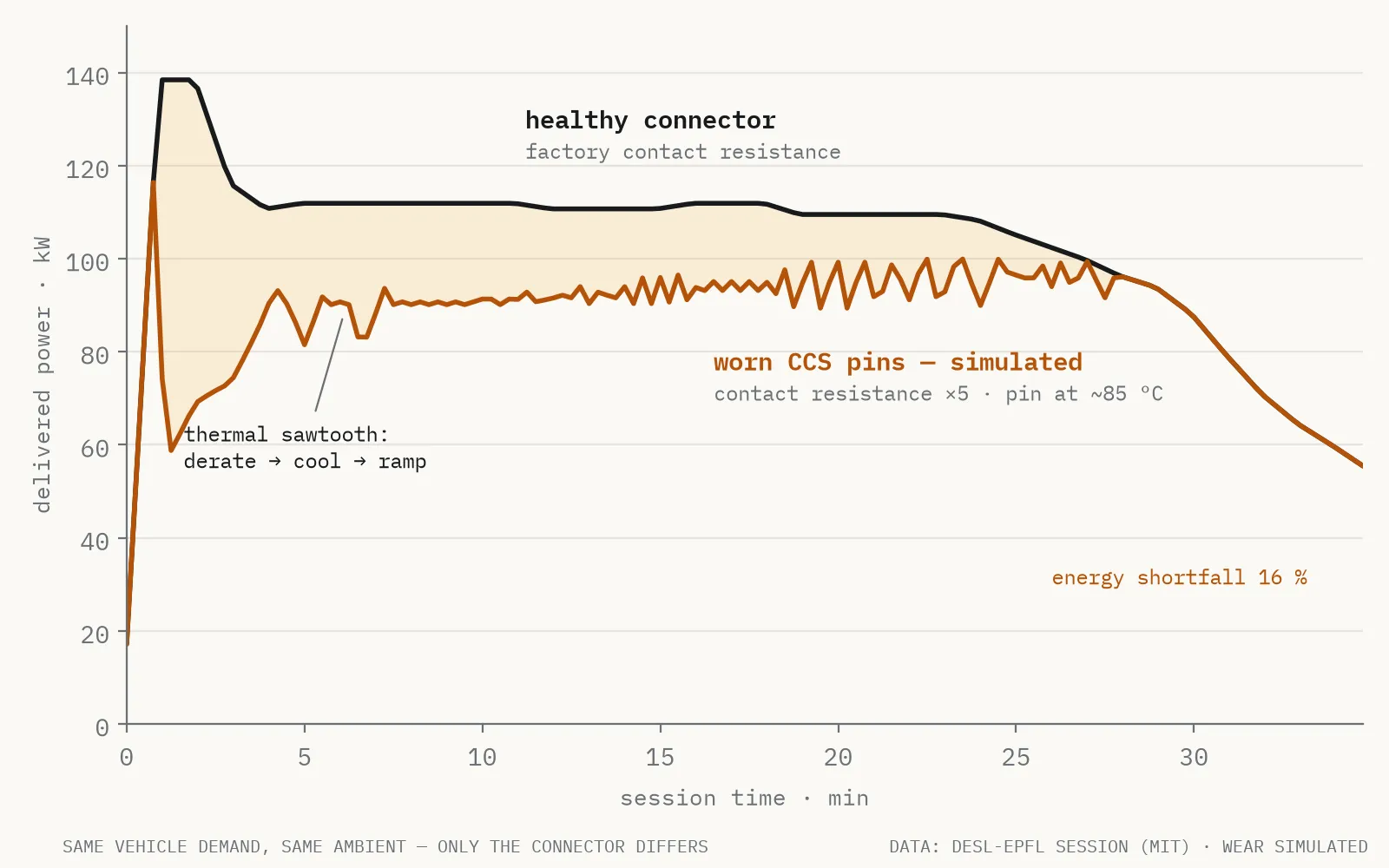
One cause is connector wear. Plug cycles abrade the pin plating and contact resistance rises. At fast-charge currents, a few extra milliohms produce hundreds of watts of heat in the pin (70 W new, 350 W worn at 375 A). The temperature sensor then forces the station to reduce power, sessions take longer, and with further wear the connector fails with a hard over-temperature fault.
The data needed to detect this already exists: OCPP meter values record power, temperature and error codes for every session. They are rarely evaluated per connector over time.
WHAT I BUILT
The prototype replays real charging sessions from a public 172.5 kW Swiss station (EPFL's open Level-3 dataset, MIT license) through a physics model of the connector: contact resistance grows with mating cycles, pin temperature follows the I²R heating, the derating controller reacts. The result is the oscillating, reduced power curve of a worn connector. All degradation is simulated and labeled as such.
Each session is reduced to a few features: energy shortfall against the vehicle's request, number of derating dips, and temperature rise normalized by current squared. The last one isolates contact resistance and separates worn pins from a degrading cable-cooling loop. Per connector, an EWMA compares each feature with control limits from its own healthy baseline. This is statistical process control, not machine learning: no training data, and every alarm traces back to a feature and a threshold.
The output is a list per connector: health score, predicted standardized error code (CX018 derating now, hard CX019 stop in N weeks) and the recommended action, for example pin replacement at the next planned visit.
PROTOTYPE RESULTS
The two failure modes produce different work orders: worn pins and a failing cable-cooling loop are identified separately instead of raising the same generic over-temperature alarm.
Status: working prototype on real session data with simulated degradation. The features come directly from OCPP meter values, ready for a pilot on an operator's live data.